

Habeas Viscus

1984 - Present
Description
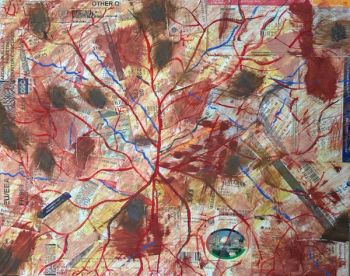
Habeas Viscus literally means, “you shall have the entrail.” The piece is a reflection on struggle, identity, borders, and mobility. The collage is made from boarding passes and tickets collected across a decade and from different countries. They represent the bureaucratic, surveillance body tracked by state apparatuses. The colors represent the fleshy assertion, where it represents the flesh of a human, reduced to bare flesh in front of bureaucratic machines. The red lines resemble both blood vessels and borders; the blue lines also represent vessels and borders that cut humans. The brown patches represent wounds, scars, and burns across life. This work tries to show how humans can move from the judicial body, corpus, to the living, discriminated viscus. This work is a representation of Habeas Viscus, a visualization of a Gazan who is surveilled, bureaucratized, and securitized—turned into living flesh, with scars, wounds, exiles, and survival. It is an act of reclaiming life from documentation and bureaucracy despite struggle. In this work, the map becomes veins and flesh, the itinerary becomes wounds, and colors become a living reminder.
Artist Notes
In 2019, I came across Alexander Weheliye’s book, Habeas Viscus. The way it was written immediately resonated with me—not only as an individual, but as a Gazan. On paper, I am often recognized as a legal subject, with rights and a passport that should, in theory, grant me recourse to justice. Yet, in many contexts—especially at airports and border crossings—I have been dehumanized, reduced to just a “Gazan,” regardless of the Swedish passport I carry. In those moments, I become a bare, exposed human body, stripped of political personhood and left vulnerable outside the full protection of the law. This encounter—being marked by my origins rather than my legal status—helped me understand Weheliye’s argument: how the flesh, the “viscus,” becomes a historical site of exclusion and hypervisibility. Later, I wrote a journal article titled “Palestine and Habeas Viscus,” exploring what it means to exist as human without ever being fully recognized as such. In that work, I tried to capture my lived experience: my body is the archive of wounds, bureaucracy, trauma, and resistance—where every scar and every border crossed is a testament to the struggle of habeas viscus. The work is not only about flesh and injury, but also about interrogation, blood, borders, and the relentless negotiation for dignity in the face of systems that attempt to erase our personhood.


